
Stop for a moment.
Listen to the forest around you. The rustling of leaves, the singing of birds, footsteps on the forest path.
It is hard to imagine that this peaceful place was once part of a busy route along which people, horses and carts loaded with wood, hay, coal and other necessities used to pass.
And right here, in the Melnik area, at the foot of Plešivac, lay one of the important sources of life for the inhabitants of nearby villages.
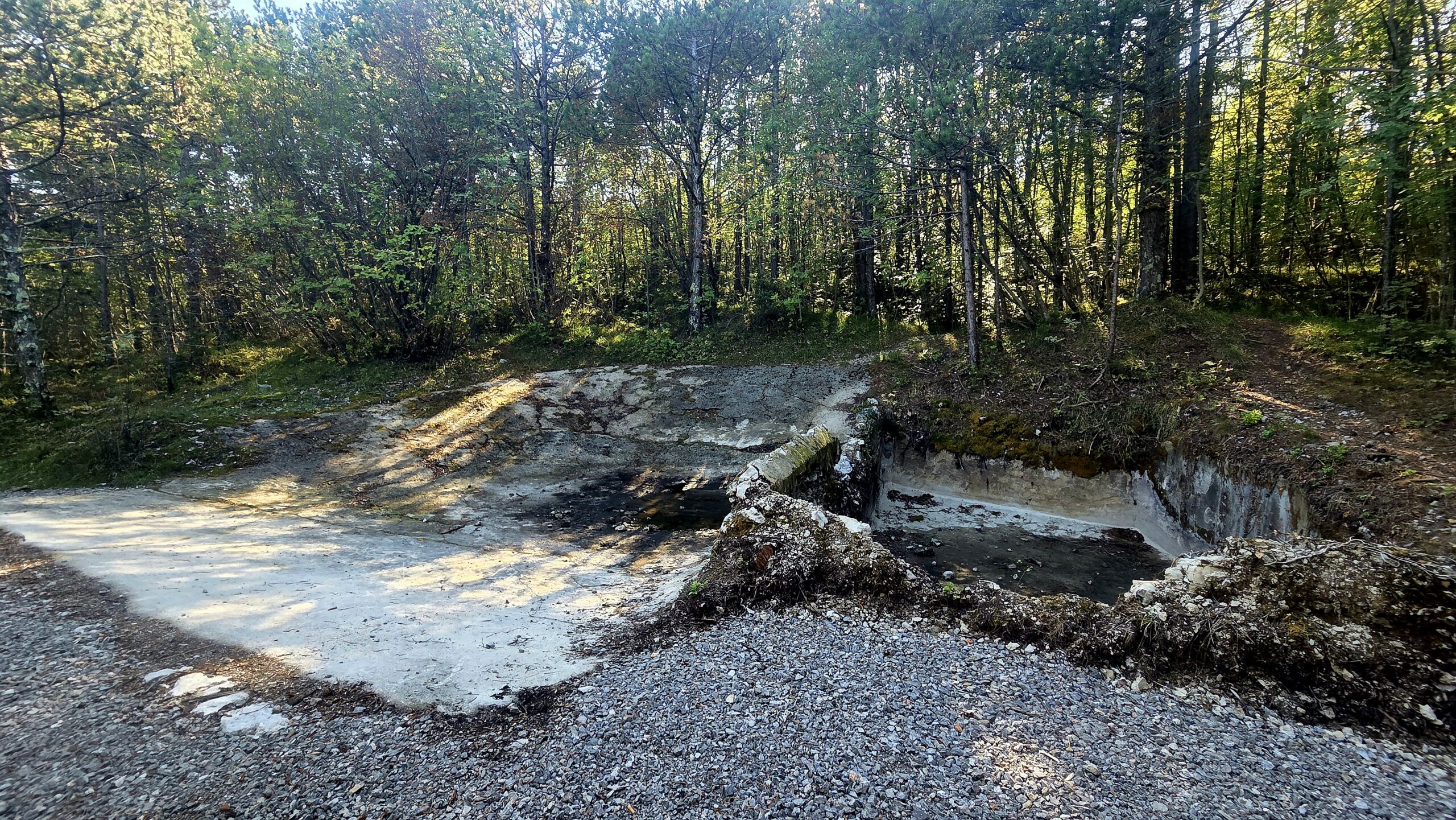
An entirely ordinary little pond – a kalić.
Or perhaps not so ordinary after all?
Let’s go back to a time when life in Halubje was completely different from today. Families worked the land, growing potatoes, beans, turnips and other vegetables, and almost every household had a cow or goat. People lived modestly, relying on what the meagre soil could provide. Yet, there was something they could not do without. Something we take for granted today.
Water.
It was not enough to simply turn on a tap. Water had to be fetched, often on foot, in containers known as brente. Every drop was precious, and kalići, ponds in hollows where water collected, were an indispensable part of everyday life.
One such kalić was located right here.
The name Melnik comes from the Chakavian word mel, meaning sand. In the past, sand was found in this area and used in construction, while nearby Plešivac takes its name from its bare, almost bald summit (plešiv means ‘bald’ in the local dialect).
When the important Rijeka–Klana road ran through this area, Melnik was a well-known resting place. Imagine a carter stopping his wagon here after a long journey. The horses approach the water, lower their heads and quench their thirst. The carter takes a break and then continues on his way.
For the inhabitants of Biškupi and Brtuni, this pond meant even more. Its water was used daily for drinking and cooking, and for watering livestock.
And this is where the most interesting part of our story begins.
Because, as so often happens, what seemed perfectly natural to some began to pose a problem for others.
Animals would enter the pond to drink, their hooves stirring up the mud on the bottom. The water that people then carried home was murky.
The year was 1896. It was summer – 24 June.
Two residents of Biškupi, Ivan Perčić and Anton Bratonja, had had enough of the situation. They believed that the water people used for drinking and cooking needed better protection and decided to take action. They went to Kastav, to the head of the municipality, with a proposal to build a wall around the pond at their own expense. This would keep animals out and help keep the water cleaner.
Their request was duly recorded by the municipal scribe Vinko. And it did not take long: the wall was built within a month.
Problem solved?
Well – not exactly.
Because not all the locals shared their opinion.
One evening, at sunset, five men gathered. Two from Biškupi and three from Brtuni. And they tore down the wall!
We can only imagine the arguments that took place among the neighbours at that time. Some wanted clean water for drinking and cooking. Others believed that the pond, as it had been for generations, should remain accessible to everyone, including their livestock.
Soon afterwards, ten residents of Biškupi and Brtuni openly opposed the enclosure of the pond. Their position was clear: this kalić had always served everyone and met all their needs. If someone wanted a separate place to collect clean water, they should ask for permission to create a new pond.
The matter once again came before the municipal authorities in Kastav. And the authorities had to find a solution.
At the end of July, a decision was made: the water from the pond could still be used for livestock, but the animals were no longer allowed to enter it freely. Instead, the water had to be brought to them in a bucket or other container. Anyone who violated this order had to pay a fine of two florins. Repeat offenders faced a harsher penalty.
However, the story was not quite finished.
About forty days later, representatives of families from Biškupi once again discussed the fate of the kalić. The prevailing opinion was that it should not be enclosed by a wall and that livestock should have free access to the water, as they had had for generations. Only Anton Bratonja remained opposed. The possibility of building a new kalić nearby was also mentioned.
However, a new pond was never built. At least, not in the way it was imagined at the time.
If you take a closer look at Melnik today, you will notice a rectangular, open cistern next to it, about a metre and a half deep. It was constructed in such a way that water from the kalić could overflow into it. Perhaps this was the way to reconcile the different needs of those who used it. We do not know when it was built, but it tells us that the appearance of this place has changed over time, just like the lives of the people who used it.
Nowadays, carters and their horses no longer gather at Melnik. There are also no locals coming every day to fetch water for cooking, or spirited debates about who is, and who is not allowed to approach the pond.
What remains are the forest, water and silence.
And a story that reminds us how precious something we take for granted today once was. For Melnik was more than just a place where people came to collect water. It was a place of encounters, conversation, disagreement and people coming together to find solutions.
A small part of the great history of everyday life in Halubje.
And perhaps, as you stand beside it today, it is worth reflecting on a question.
How differently would we see water if, like the people of Biškupi and Brtuni in the past, we had to come here for every single drop?
So, before you continue your walk, take another look at this old kalić.
Seemingly peaceful and quiet, Melnik still has many stories to tell.

This project was realized thanks to the funds of the Croatian National Tourist Board from the Public Tender for the allocation of funds for local tourist board projects in underdeveloped tourist areas and the continental region in 2026, from the Fund for Underdeveloped Tourist Areas and the Continental Region.